
Custom Micro Switch Supplier: Tailored Solutions for Precision Applications
2026-11-16
Precision applications demand components that go beyond off-the-shelf limitations. When standard micro switches just won't cut it, KEJIAN ELECTRONICS steps in with fully customized solutions—engineered for your exact load, travel, and durability requirements. This blog unpacks how tailored micro switch design can unlock new levels of performance and reliability in your most critical systems.
How Micro Switches Shape Precision in Medical Devices
Micro switches might be tiny, but in the medical field, they carry massive responsibility. When a surgeon grips a robotic instrument, the exact moment of actuation—and the tactile feedback that confirms it—relies on a switch that repeats its performance without drifting even a thousandth of an inch over millions of cycles. That level of consistency doesn’t just improve a device; it defines whether a procedure feels seamless or uncertain in the clinician’s hands. By removing almost all variation in release force and travel distance, these components turn complex electromechanical systems into tools of instinctive control.
The real craft lies in how micro switches handle the quiet, repetitive tasks inside diagnostic and life-support equipment. Inside an infusion pump, a switch no larger than a fingernail might verify that a cassette is locked, or that a door hasn’t been nudged mid-delivery. If that signal lags or bounces, the pump’s algorithm could misinterpret a continuous occlusion as a false alarm—or worse, ignore it altogether. Designers select switches with hair-trigger actuation points and minimal contact resistance so that every mechanical event translates cleanly into a digital truth, letting software make fast, accurate decisions without second-guessing the hardware.
Precision in medical devices also means surviving an environment that attacks reliability from every angle: sterilization gases, saline splashes, vibration during transport, and years of idle time punctuated by sudden emergencies. A well-chosen micro switch doesn’t just endure these conditions; it stays predictable through them. Its sealed construction guards against fluid ingress, while gold-plated contacts resist oxidation that could muddy a signal. That’s the kind of thoughtful engineering that often goes unnoticed—until you realize the ventilator that sat in a warehouse for two years boots up and senses its limit-switch home position with the same timing accuracy as the day it was calibrated.
Material Choices That Redefine Switch Durability
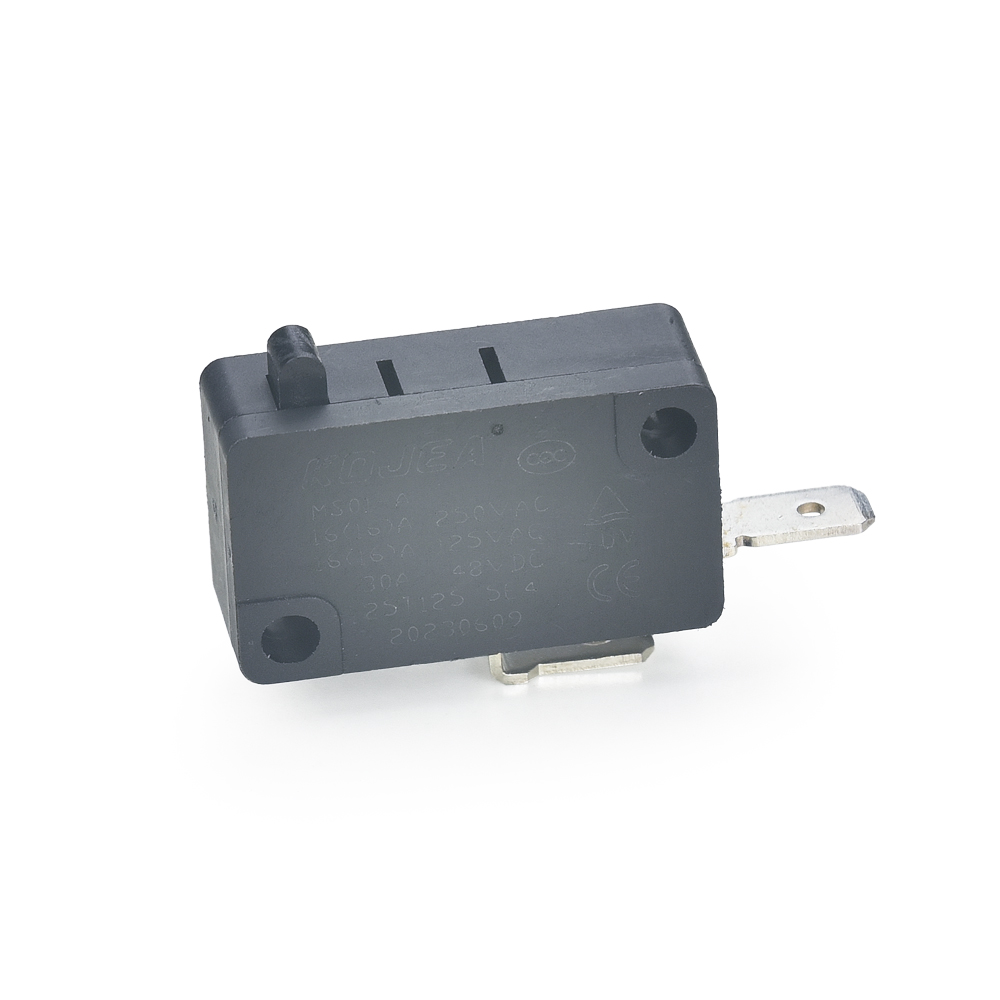
Durability in a switch isn’t just about how many clicks it can survive—it’s about what happens when heat, humidity, and constant friction start to grind away at the internals. Rather than defaulting to generic thermoplastics, some manufacturers are turning to glass-reinforced nylon blends that resist warping even after years of aggressive use. This shift means the housing stays rock-solid under stress, keeping the stem and spring precisely aligned long after a standard housing would have loosened and started to rattle.
Contact materials often get overlooked, but they’re where the real battle against wear takes place. Gold alloy contacts can maintain signal clarity through millions of cycles, yet they demand careful engineering to avoid oxidation at the edges. A more interesting path is the use of self-lubricating composite alloys that shed debris instead of building up carbon scoring. These materials let the switch settle into a smooth, predictable feel over time, rather than gradually growing scratchy or inconsistent.
The stem and leaf spring deserve just as much scrutiny. Where basic designs rely on simple copper alloys that fatigue and lose snap, a shift toward beryllium-copper or custom stainless steel formulations can keep actuation force stable far beyond the typical lifespan. It’s not just about surviving a high cycle count—it’s about making sure the 80-millionth press feels as crisp and deliberate as the first one, without the mushiness that gives away a cheaper build.
Custom Actuator Designs for Unique User Interactions
Off-the-shelf actuators rarely capture the subtle feedback a creative interface demands. When the goal is a whisper-soft pulse under a fingertip or a deliberately weighted resistance that changes mid-gesture, a tailored mechanism transforms the interaction from functional to meaningful. We sculpt these devices from the ground up, blending unconventional materials with motion profiles tuned to the exact moment a user expects a response — and sometimes, the moment they don’t.
The real magic hides in constraints most designers overlook. A rotating dial that clicks with satisfying detents might also need to coast silently when nudged, requiring a hybrid magnetic and viscous damping system no catalog offers. By rethinking geometry, coil windings, and even the alloy of a spring, we create behaviors that feel less like a machine and more like a natural extension of intent.
What often seals the deal is how these custom builds embed themselves into the user’s mental model. A slight kick at the end of a volume slider, a breath-like resistance when you press a privacy toggle — these aren’t gimmicks but learned responses the body comes to trust faster than any graphic. In a world saturated with glass rectangles, a physical conversation you can’t find anywhere else is what people remember.
Sealing Standards That Go Beyond IP Ratings
Many assume that IP ratings — those familiar two-digit codes — tell the whole story when it comes to sealing performance. In practice, they only scratch the surface. Real-world protection against dust, moisture, and pressure cycles often demands design choices that no standard test can certify. That’s why our engineering teams spend as much time on material creep, gasket compression set, and thermal cycling as they do on passing static laboratory dunks.
We’ve moved beyond the pass/fail mindset by testing enclosures under sustained vacuum, rapid altitude shifts, and high-pressure spray from multiple angles simultaneously. These aren’t industry requirements — they’re questions our field data asked us to answer. The result is a sealing architecture that stays reliable when equipment moves from conditioned labs to coastal salt spray, sub-zero assembly lines, or washdown environments where water hits at 1,000 psi.
Instead of just asking “what IP level does this meet,” our partners now look at lifetime sealing integrity. That means evaluating how the housing breathes during daily temperature swings, how the O-ring retains its memory after ten thousand thermal shocks, and whether the enclosure can still keep moisture out after years of vibration from nearby machinery. When your standard is a decade of trouble-free operation, the rating on a datasheet is only where the conversation begins.
Integrating Micro Switches into Compact IoT Hardware
Fitting a micro switch into a tight IoT enclosure demands more than just checking dimensions on a datasheet. The physical footprint matters, but so does the actuation force and the travel distance before the click. In battery-powered sensors or wearables, a switch that requires a firm press can become a daily annoyance, while one with overly light touch might trigger false signals from vibrations or case flex. Designers often spend more time testing the feel and repeatability of these tiny components than they do on the wireless module, simply because the switch is one of the few parts a user physically interacts with.
The choice between a standard snap-action switch and a sealed version can make or break long-term reliability in compact hardware. Even indoors, condensation, dust, and the occasional coffee spill creep into millimeter-sized gaps. IP-rated micro switches add a few cents to the bill of materials but eliminate the most common field failures we see—contacts corroding or sticking after a year of passive exposure. For edge devices installed in kitchens, garages, or outdoor sensors, a sealed switch paired with a conformal coating on the PCB is often the difference between a product that lasts a full lifecycle and one that gets returned within six months.
Wiring a micro switch into a constrained layout usually forces trade-offs between mechanical placement and antenna keep-out zones. The metal body of a switch can detune an onboard antenna if placed too close, especially in LoRa or BLE designs where every decibel of link budget counts. A common workaround is to shift the switch to the board edge and use a small actuator lever, or to move the antenna to the opposite end, but that assumes the industrial designer hasn’t already locked the exterior button location. Early collaboration between the EE and the ID team avoids the last-minute scramble where someone suggests reducing the switch to a tactile dome on a flex PCB, which rarely provides the same crisp feedback or service life as a proper micro switch.
From Prototype to Production: Speed Without Compromise
Moving from a working prototype to a production-ready system often gets stuck in a cycle of rework and over-engineering. The real challenge isn't just writing code faster—it's eliminating the friction between 'it works on my machine' and 'it runs reliably at scale.' We treat speed as a design constraint rather than an afterthought. By automating environment provisioning, enforcing lightweight architectural boundaries early, and running integration checks on every commit, the gap between prototype validation and production deployment shrinks dramatically without introducing hidden fragility.
Tooling choices make or break the pace. Instead of chasing novelty, we lean on battle-tested platforms that reduce boilerplate but don't lock us into rigid patterns. Containerized development setups mirror production from day one, so surprises surface in minutes rather than during a late-stage audit. Database schemas evolve alongside the prototype through migration pipelines that roll back cleanly, letting the team refine the data model without pausing feature work. This keeps technical debt from accumulating silently while the product takes shape.
Speed without compromise demands a culture that separates fast iteration from careless shortcuts. We invest upfront in modular telemetry and feature flags, turning every prototype feature into an experiment that can be dialed up or down in production without redeployment. When a spike in user activity reveals a bottleneck, the team doesn't abandon speed—they tighten the feedback loop further, pairing real-time observability with small, reversible architectural adjustments. The result is a rhythm where production deployments happen multiple times a day, yet incident rates stay flat because risk is continuously designed out rather than bolted on later.
FAQ
A custom micro switch is engineered to meet specific electrical, mechanical, and environmental requirements that off-the-shelf parts simply can't cover. It might involve unique actuator shapes, special terminal configurations, tighter operating forces, or the use of materials that withstand extreme temperatures or chemicals—details that are refined through direct collaboration between the supplier and the client.
If your project involves tight space constraints, unusual voltage or current levels, specific force curves, or exposure to moisture, dust, or vibration, then a tailored switch is worth exploring. Typically, when the standard options force you to compromise on reliability or product design, it's time to talk through the exact demands with a supplier who can adapt the component from the ground up.
Medical devices, aerospace controls, precision automation, and high-end consumer electronics all benefit significantly. In these fields, even a millimeter of extra travel or a slight difference in actuation force can mean the difference between flawless operation and a failure that impacts safety or user experience.
It starts with a detailed review of your mechanical layout, electrical targets, and environment. From there, our team proposes a design—often starting with 3D models and prototypes—and we test it under real-world conditions. You'll typically see several iterative samples before final validation, with full transparency on materials, compliance testing, and lead times so there are no surprises.
It depends on the industry, but we frequently work with UL, ENEC, and IEC standards, as well as RoHS and REACH compliance. For medical or military uses, additional standards like ISO 13485 or MIL-STD may apply. A good supplier will have the documentation and traceability ready without you having to chase for it.
We maintain a controlled bill of materials and often keep safety stock of critical components. A dedicated project file preserves all specs, tooling drawings, and test reports so that reorders—even years later—match the original performance exactly. Regular communication about your forecast also helps us plan production slots and avoid bottlenecks.
Conclusion
Precision isn’t handed to a device—it’s built layer by layer, often starting with the smallest electromechanical component: the micro switch. In medical tools where a fraction of a millimeter defines success, a switch must do more than open and close a circuit. It becomes the quiet arbiter of repeatability. That’s where a true custom supplier steps in, not with a catalog, but with a conversation. The right material choice can mean the difference between a switch that drifts after ten thousand cycles and one that stays locked in after ten million. Gold-flashed beryllium copper, glass-filled PPS housings, hardened silver alloys—these aren’t just specs on a datasheet, they’re deliberate responses to environments where chemical washdowns and constant actuation erode lesser parts. Custom actuators take this further. A curved leaf, a telescoping plunger, a magnetic override—each is shaped not to match a generic footprint, but to suit how a surgeon’s gloved hand or a patient’s subtle breath interacts with the device. Durability isn’t an accident; it’s a negotiation between force curves and finger ergonomics.
Yet durability on paper means little if it unravels in the real world. Sealing standards that genuinely outperform IP numbers require more than a rubber boot—hermetic glass-to-metal bonding, dual-chamber venting, and laser-welded housings create barriers that laugh at autoclave cycles and saline ingress. When these switches migrate into compact IoT hardware, the design puzzle intensifies. Space shrinks, current draws drop, but the tactile certainty must remain. A supplier that understands this won’t just miniaturize; they’ll reimagine internal geometries, pushing the snap-action mechanism into spaces smaller than a coffee bean without losing that crisp, confidence-giving click. And none of this matters if the journey from prototype to production bleeds away months. The real tailored solution lies in collapsing that timeline—offering rapid stereolithography for actuator blanks, maintaining a living library of pretested subcomponents, and running concurrent life-cycle validations. It’s about moving fast without letting tolerances drift, ensuring that the micro switch in the final assembly doesn’t just function; it belongs there, as if the device had grown around it.
Contact Us
Contact Person: Anna lin
Email: [email protected]
Tel/WhatsApp: +86 13567768885
Website: https://www.kjele.com/