
High Speed PVC Twin Pipes Extrusion Line: How It Boosts Production Efficiency
2026-11-29
Ask any plant manager what actually separates a profitable extrusion line from a costly bottleneck, and they'll rarely point to horsepower alone. What matters more is how well the system handles thin-wall, high-velocity PVC pipe without sacrificing wall consistency or wasting cooling time. That's where COMRISE has carved out a reputation: twin pipes running side by side, sharing one downstream, while keeping output numbers that make single-strand lines look sluggish. In this article, we'll pull apart the design choices behind that speed boost — and show you why real production gain has more to do with synchronization than raw screw speed.
Speed Gains That Start Inside the Extruder
The fastest line speeds rarely come from a bigger motor or a more aggressive puller. They come from what happens in the barrel long before the melt reaches the die. When the screw geometry is matched to the polymer's melting behavior, the extruder can run at higher rpm without pushing unmelted material downstream. That means fewer pressure spikes and less time spent dialing back the speed to protect dimensional tolerances.
A well-designed barrier section or mixing element changes the usual trade-off between output and melt quality. Instead of relying on high shear to finish melting, the screw spreads the polymer into thinner melt films and keeps the solid bed from breaking apart. The result is a more uniform melt temperature across the flow, so raising the line speed does not automatically create surface defects or die-lip buildup.
Temperature control inside the extruder also plays a bigger role than many operators expect. By placing heating and cooling zones where the polymer actually absorbs or releases energy, the barrel avoids wild swings that force conservative settings. Once the internal heat profile stays stable, operators can push the line closer to its real capacity without chasing bubbles, streaks, or gauge variation.
Twin Pipes Without Expanding the Line Footprint
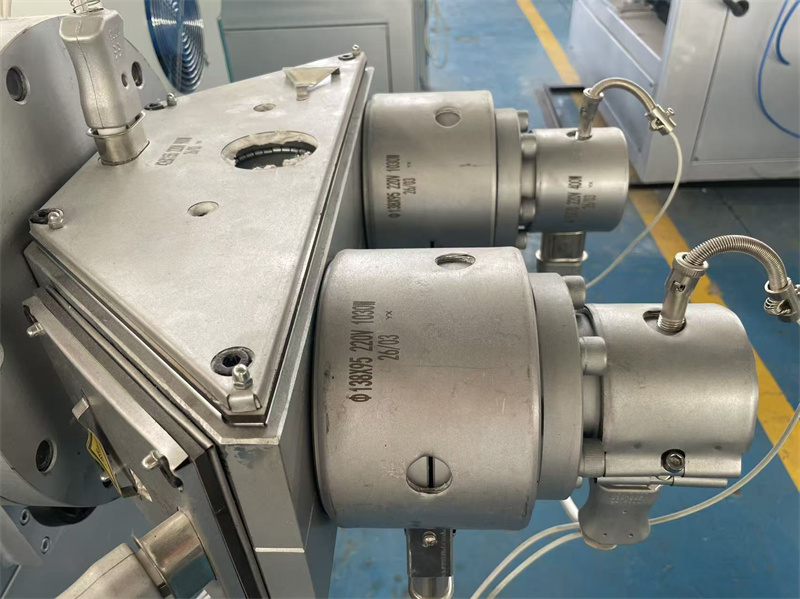
Running a second pipe beside an existing line usually means widening the rack, shifting access roads, or redrawing plot boundaries. The twin-pipe arrangement avoids that conversation by pairing supply and return lines within the same support bay and holding clearances to the code minimum, so both pipes travel through the original corridor without crowding adjacent equipment spaces.
The work is less about squeezing and more about sequencing. Pipe shoes, guides, and anchors are placed so each line can move under thermal load without colliding with its neighbor or the structure. A shared but carefully detailed support frame carries both lines, which reduces steel counts and keeps the foundation width unchanged.
In the field, that means fewer civil changes and shorter downtime. Crews can set both pipes in the same lift or stage them without shifting the rack, and future inspection points stay reachable from the existing walkway. What reads as a tight fit on the drawing becomes a practical capacity increase that leaves the line footprint untouched.
Energy Demand Per Meter Falls as Throughput Climbs
Higher line speeds usually bring higher absolute energy bills, but the amount of power needed to move a unit of work across a meter of infrastructure tends to drop as utilization grows. Fixed losses in converters, cooling, and control electronics get spread across far more traffic or product flow, so each additional unit absorbs a smaller share of the standing overhead. The result is a downward-sloping energy-per-meter curve that flattens only when equipment approaches its thermal or mechanical ceiling.
That shift is rarely uniform. Chillers, pumps, and power distribution gear often run in efficiency bands that improve with load, while motor-driven systems may see most of the gain only after throughput passes a certain threshold. Operational schedules matter too: running longer at moderate load can cut energy per meter more than short bursts at peak, even when the headline throughput number looks impressive. Teams that monitor this metric instead of total consumption tend to spot constrained sections where per-meter demand stops falling and use that signal to stage upgrades.
Scrap Reduction Without Extra Line Stops
Most of the real progress comes from reading the line before it misbehaves. A slight shift in spindle load, a change in chip color, or a fixture that needs a little more clamp pressure can indicate that a part is drifting toward the reject pile. Acting on those signals during the normal cycle avoids both scrap and an unscheduled stop.
Tool wear data makes this more repeatable. Instead of running a batch and sorting good from bad afterward, wear rates can be compared against the tolerance band so offsets are updated while the process is still stable. That keeps dimensional drift inside the acceptable range without pulling the line down for a separate inspection event.
There is also a quieter source of waste in how parts move between stations. Nicks, burrs, and contamination tend to happen when stacking or transfer methods go unchanged for too long. Simple adjustments to racks, trays, or protective edges can remove those defects at the source and leave the production rhythm untouched.
Holding Wall Thickness at Maximum Output
High-speed production shifts the way melt behaves inside the tool. Shear heating rises, pressure fluctuations widen, and the cooling window shortens, so the thin sections tend to lose wall thickness first. Once the machine reaches maximum output, it is usually a race between fill speed and freeze-off, and any imbalance in the flow path becomes visible as uneven walls.
Keeping thickness stable at that pace rarely comes down to simply raising injection pressure. It helps more to divide the mold or die into smaller thermal zones and adjust them individually. Small changes in barrel back pressure, screw recovery speed, and cooling circuit balance can hold the wall dimension without sacrificing cycle time. In practice, fixing the maximum output as a target and measuring wall variation section by section often reveals two or three temperature zones that are doing most of the work.
Material consistency is the other half of the problem. Melt flow variations between batches, or a change in regrind content, can shift how the material packs at high speed. A short-shot check after a batch change shows whether the flow front is still symmetric, and from there you can compensate with barrel temperature or hold pressure before the drift turns into scrap.
Full-Speed Production and the Cost per Meter Shift
Running a line at full speed rarely means costs simply drop. Fixed overhead gets spread across more meters, but the real shift in cost per meter depends on how the operation behaves under pressure: changeovers disappear, labor is used more continuously, and small inefficiencies stop hiding in idle hours.
There is a threshold where pushing beyond comfortable capacity changes the math. Overtime premiums, faster tool wear, higher rejection rates, and rushed material handling begin to appear in the per-meter figure. The gain from volume can quietly turn into a penalty once the line stops recovering cleanly from minor disruptions.
A more useful way to read the shift is to track cost per meter against output stability, not just volume. When full-speed production holds without frequent stops, the number tends to fall and stay low. When it depends on constant firefighting, the metric becomes noise, and the apparent efficiency is often borrowed from the next shift.
FAQ
A twin line uses one extruder feeding a double die head and shared calibration, haul-off, and cutting units. You get two finished pipes from a single footprint, so floor space, energy per kilogram, and operator workload drop compared with two independent lines.
Because the extruder, heating zones, drives, and controls are shared, the line runs closer to one combined throughput rather than two separate energy loads. Heat losses are lower relative to output, and specific energy use per meter of pipe typically falls as line speed rises.
Vacuum calibration tanks with enough cooling length and stable vacuum levels are the main factor. Precise haul-off speed control and synchronized cutting also prevent stretching, ovality, and length errors when the line is moving fast.
Yes, but it depends on gravimetric feeding or consistent dry blend flow, correct screw temperature control, and well-maintained vacuum sizing. Closed-loop wall thickness or diameter monitoring helps make fast adjustments before scrap is produced.
Dry blend consistency, bulk density, thermal stability, and gelation behavior matter more than at low speed. A batch that varies in lubricant level or moisture can quickly cause surging, burn marks, or unstable dimensions when throughput is high.
It depends on pipe diameter and wall thickness, but output can move from roughly 400-600 kg/h on an older single line to 800-1,200 kg/h or more on a twin high speed line. The bigger gain is often lower labor and energy cost per meter, not just raw tonnage.
Usually not. The die head, calibration tables, haul-off, and cutter are designed around a specific pipe layout and speed range. Retrofitting tends to cost close to a new line while leaving you with mismatched cooling capacity and control limits.
Check screw and barrel wear on schedule, keep calibrators clean, inspect haul-off belts for slip, and replace cutter blades before they get dull. Small misalignments that are harmless at low speed become scrap and downtime at high line speeds.
Conclusion
The practical productivity gain in a high speed PVC twin pipes extrusion line shows up long before the finished pipe reaches the haul-off. Screw geometry, barrel temperature zones, and the feed section are matched to accelerate plastication, so the melt arrives at the die already homogeneous and ready to run. That internal head start lets the extruder sustain a faster line speed without hunting or surging. Because two pipes then share the same downstream path, the floor footprint barely changes while output per square meter climbs sharply. Energy consumption does not rise in step with that added output; it falls for every meter of pipe as throughput increases, since fixed loads are spread across more finished product. This quietly shifts the economic baseline before waste is even measured.
At full line speed, the real test is dimensional control. The vacuum calibration and cooling sections are tuned to hold wall thickness within a tight band while the haul-off runs at maximum output, so operators do not have to ease off or stop the line for drift. Fewer stops translate into fewer cut-offs, less regrind, and lower start-up scrap. That reduction comes without adding extra line downtime, which keeps the overall process flowing. Combined with the lower energy draw per meter, this stability moves the cost per meter in the right direction at the top of the speed range. In practice, the line becomes more economical the closer it runs to full output, turning high speed from a stress condition into the most profitable operating setting.
Contact Us
Contact Person: LISA LEE
Email: [email protected]
Tel/WhatsApp: +86 13780696467
Website: https://www.qdpipemachine.com