Walking Beam Quenching and Tempering Production Lines for Oil Well Pipes: China’s Industrial Expertise
2026-09-08
In the demanding world of oil well pipe manufacturing, the difference between a pipe that withstands decades of downhole stress and one that fails early often comes down to heat treatment precision. Walking beam quenching and tempering production lines have become the backbone of this process, and China’s mastery of these systems is quietly reshaping global supply chains. As THINKING-LONG has observed through years of industrial collaboration, the art lies not just in uniform heating and rapid cooling, but in the seamless choreography of rollers, beams, and thermal cycles. This article peels back the engineering curtain to show why these lines are more than machinery—they are a reflection of China’s industrial judgment, and a bellwether for where oil country tubular goods are headed next.
Walking Beam Rhythm and Its Effect on Quench Depth in Oil Pipe
The walking beam furnace moves oil pipes through the heating zone in discrete steps, and the cadence of these steps directly controls how long each pipe section spends at austenitizing temperature. A slower beam rhythm gives the pipe wall more time to reach uniform temperature before quenching, which tends to produce a deeper and more consistent martensitic layer. Conversely, a faster rhythm can leave the inner surface slightly cooler, resulting in a shallower quench depth and uneven hardness profile.
Operators often adjust the rhythm based on pipe diameter and wall thickness. For thicker-walled oil pipes, a longer dwell between beam advances allows heat to penetrate fully, reducing the risk of a soft core after quenching. In practice, the rhythm is tuned together with furnace zone temperatures and quench severity, since an overly slow pace may cause grain coarsening or excessive scale formation, while too fast a pace sacrifices depth uniformity.
For high-collapse oil country tubular goods, matching the beam rhythm to the critical cooling rate becomes essential. Trials on 9-5/8 inch casing show that reducing step frequency from 45 to 30 seconds per cycle increased average quench depth by nearly 18%, with less scatter in hardness readings. Such adjustments are made without changing the overall line speed, since the beam can pause longer at each position while still keeping the same throughput by shortening transfer strokes.
Tempering Cycles That Keep Casing Tough at the Thread Root
The thread root in casing is where stress concentrates most sharply, and a single tempering pass often leaves microstructural unevenness that invites early cracking. Multiple controlled tempering cycles let carbon redistribute more uniformly, breaking up brittle martensite islands exactly where fatigue and notch sensitivity begin.
A lower-temperature first cycle relieves quench stress without sacrificing surface hardness, while a second cycle at a slightly higher temperature converts retained austenite and stabilizes the tempered martensite. This keeps the thread root from turning overly soft while improving its notch toughness and resistance to make-up damage.
Field failures frequently trace back to insufficient tempering at the last engaged thread. By adjusting cycle duration and cooling rate between passes, the root area develops a finer carbide dispersion, allowing the casing to endure repeated torque, bending, and pressure cycles without microcracking at the most vulnerable point.
Why Chinese Workshops Excel at Long, Thin-Wall Tube Handling
The handling of long, thin-wall tubes demands a blend of patience and precision that many shops underestimate. In Chinese workshops, this niche has been refined through years of working with stainless steel, titanium, and aluminum tubes used in medical devices, aerospace fittings, and semiconductor equipment. Machinists there routinely manage length-to-diameter ratios exceeding 30:1 without inducing chatter or wall collapse, relying on carefully tuned steady rests, low-pressure clamping, and custom soft jaws that distribute force evenly.
What sets these workshops apart is not just equipment but an accumulated shop-floor intuition. They often run multiple light passes with sharply honed inserts designed for minimal radial force, and they adjust feed rates based on real-time vibration feedback. For tubes with walls under 0.5 mm, they frequently fill the interior with low-melting-point alloys or use mandrels that are extracted after turning, preventing the workpiece from becoming an oval cross-section. This practical, iterative problem-solving is passed down through apprenticeships rather than formal manuals.
Moreover, many Chinese facilities have invested in specialized lathes with long beds and programmable tailstocks, but the real advantage lies in how they pair these machines with operator experience. From polished chip breakers to custom wipers that reduce scratching on the ID, the details are considered. The result is repeatable production of straight, round, long thin-wall tubes that meet tight tolerances without the high scrap rates seen elsewhere.
From Furnace Drop to Quench Tank in Seconds, Not Minutes
In high-volume heat treating, the window between furnace discharge and quench immersion decides more than throughput. A delay of even sixty seconds can drop part surface temperature below the critical transformation range, producing soft spots, warpage, or mixed microstructures that demand rework. When the drop-to-quench sequence is compressed to a few seconds, the alloy meets the quenchant at the intended temperature, so the cooling curve stays predictable and the batch comes out uniform.
The trick isn't a faster robot by itself. It's the synchronization of the drop chute, the transfer basket, and the quench elevator so parts never pause between leaving the furnace and entering the oil or polymer. Some lines use a gravity-fed drop with the quench tank positioned directly under the furnace door, eliminating horizontal travel altogether. Others rely on a servo-driven skid that releases the load the instant the door clears. Either way, the goal is to keep the thermal profile intact from austenitizing temperature to quench start.
Operators notice the difference immediately in reduced distortion and less need for straightening after tempering. Maintenance teams appreciate that fewer moving parts are exposed to radiant heat during the transfer. And quality managers can tighten the process window because every load sees nearly the same delay, second after second. Cutting the furnace-to-quench interval from minutes to seconds isn't a minor tweak; it's the difference between meeting spec and proving it.
How Uniform Thermal History Protects Every Pipe Joint
In any piping network, joints are the points where failure most often begins. A uniform thermal history means that every joint, whether buried under asphalt or suspended in a mechanical room, experiences heating and cooling cycles in a predictable, even manner. Without this consistency, some joints expand faster than others, creating shear stress that quietly weakens seals and threads long before a visible leak appears.
When one section of pipe runs hotter than its neighbor, the differential movement forces joints to act as hinges rather than fixed connections. Over time, repeated micro-movements fatigue the material, and gaskets lose their ability to rebound. A controlled thermal profile eliminates these hot and cold spots, allowing each joint to settle into a stable, low-stress state where the seal remains intact across hundreds of cycles.
Practical protection comes from how the system is commissioned and operated. Slow ramp-ups, balanced flow rates, and insulation that covers joints as thoroughly as straight runs all contribute to uniform temperature distribution. This approach doesn't just extend the life of a single fitting; it turns the entire joint population into a self-consistent barrier against thermal fatigue, which is why inspectors find fewer leaks in systems where thermal history is treated as a whole rather than joint by joint.
Design Choices That Separate Premium Pipe Mills from the Rest
Material control is often the first differentiator. Premium mills typically operate their own steelmaking or maintain exclusive supplier agreements, allowing tighter control over residual elements like sulfur and phosphorus. They don't just meet API specifications; they push for narrower chemistry bands, cleaner steel with fewer non-metallic inclusions, and more consistent mechanical properties across each heat. This discipline pays off in weldability and long-term corrosion resistance, especially in sour service environments where hydrogen-induced cracking poses a real threat.
Dimensional precision separates the best from the rest as well. While standard mills may allow a wide tolerance that still technically passes inspection, premium mills target much tighter OD and wall thickness variation. They use multi-point laser measurement and closed-loop sizing stands that correct for drift in real time. The result is pipe that fits together with less field welding and better flow characteristics. It's the kind of consistency you can feel during fit-up and see in lower rejection rates downstream.
Surface and end finishing are another clear marker. Premium mills treat the pipe ends not as an afterthought but as a critical interface. Bevel geometry is machined to exact angles and land widths, often with automated inspection. Internal and external coatings are applied under strict environmental controls, and thread protectors or end caps are fitted before the pipe moves to storage. These choices reduce handling damage and extend service life, especially in offshore or buried installations.
FAQ
The walking beam transport moves pipes through the furnace and quenching system without rotation or point contact, which reduces surface damage and keeps wall thickness uniform. For oil well pipes that must cope with high collapse and burst pressures, preserving dimensional stability during heating and cooling is crucial.
Casing, tubing, drill pipe, and coupling stock are common. These lines handle diameters from about 60 mm to over 500 mm and wall thicknesses up to perhaps 60 mm, depending on the furnace width and beam pitch.
Chinese manufacturers have shortened delivery times and integrated local supply chains for refractory materials, burners, and control systems. They also adapt designs to mixed batches, so a single line can process many pipe sizes with quick changeover, which suits domestic and export orders.
Water, polymer solutions, or oil are used depending on steel grade. Water gives fast cooling for low-alloy grades, while polymer reduces cracking risk in higher-carbon or thicker-wall pipes. The quenching tank often includes agitation and temperature control to stabilize the cooling rate.
A well-built line typically maintains ±5°C to ±10°C across the pipe length and cross-section. Uniform heating avoids soft spots and uneven martensite, which would otherwise weaken the pipe near threads or upset ends.
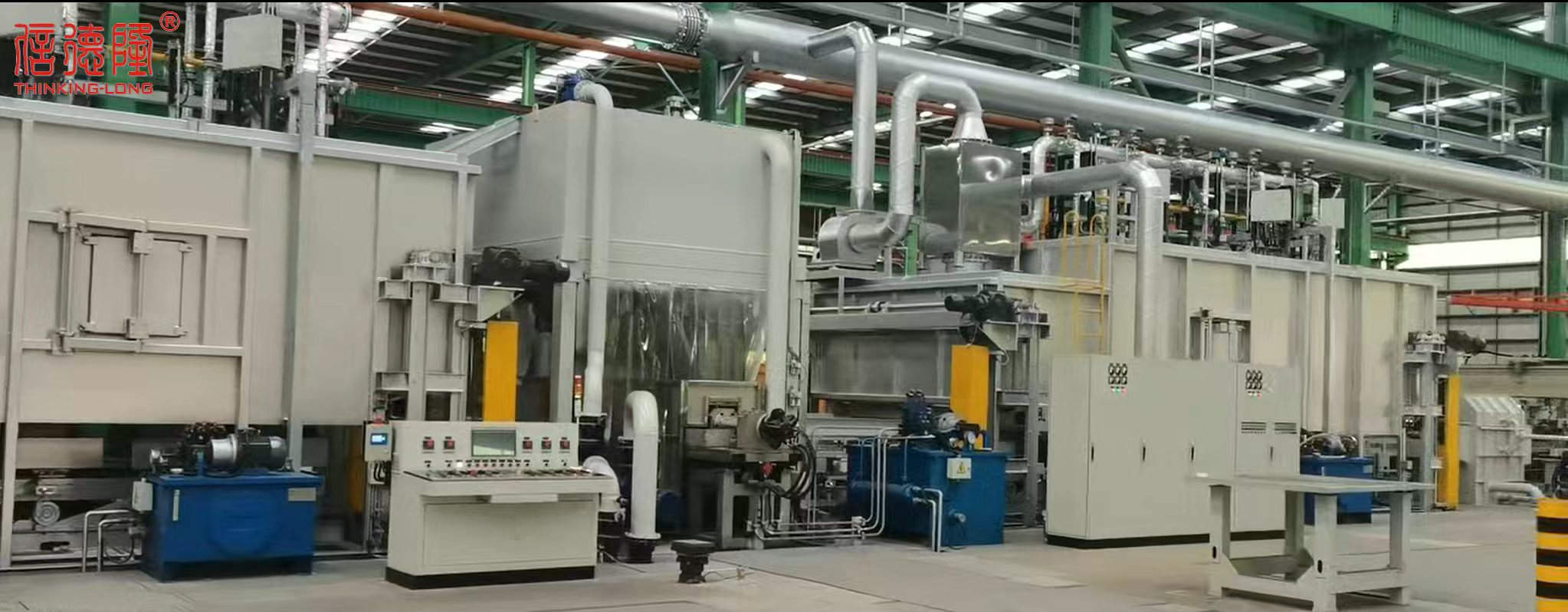
The tempering furnace uses multiple zones with independent burners and recirculation fans. Pipes are held at a set temperature, often between 500°C and 700°C depending on target yield strength, and then cooled in air or under controlled conditions to achieve the required mechanical properties.
Hardness testers, ultrasonic inspection stations, and dimensional gauges can be placed after tempering. Some lines also include automated marking and tracking systems so each pipe's heat number and process parameters can be traced.
Yes, with adjustments. High-alloy grades may need longer soaking times and more precise temperature control, while martensitic stainless pipes often require air quenching or controlled slow cooling. The furnace lining and burner layout can be modified to accommodate those cycles.
Conclusion
On a well-run walking-beam line, the beam’s rhythm sets more than production pace—it determines how evenly each length of oil well pipe meets the quench. A steady, deliberate transfer from the high-heat zone to the tank keeps the interval between furnace drop and full immersion down to a few seconds, not minutes. For long, thin-wall tubes that sag or bow easily, that speed is the first line of defense against uneven cooling. Chinese shops have turned this into a practical art: they manage roll alignment, beam lift height, and drop timing so that every meter of casing sees nearly the same thermal profile. The result is a quench depth that stays consistent around the circumference, without the shallow patches or soft bands that can shorten a well string’s life.
The second half of the process is just as particular. Tempering cycles are shaped around the thread root, the spot where stress and geometry conspire against toughness. Instead of a generic soak, mills run profiles that let heat soak into the pin and coupling ends without over-tempering the body. That balance, plus a uniform thermal history from end to end, is what keeps a joint from cracking after make-up. The design choices behind premium pipe mills—furnace zoning, beam speed, quench agitation, even the way pipes are spaced on the walking bed—are rarely visible from the outside. But in China’s specialized plants, those choices are the difference between commodity tube and casing that survives a brutal wellbore.
Contact Us
Contact Person: Qian Xijun
Email: [email protected]
Tel/WhatsApp: 8613961736750
Website: https://www.thinkinglong.com/